
The OECD promotes better policies for better lives in countries of all income levels. It works with public and private partners around the world to improve sustainable development outcomes, and encourage more effective, transparent development co-operation and financing.

1. Development co-operation
The OECD designs international standards and guidelines for development co-operation, based on best practices, and monitors their implementation by its members. It works closely with member and partner countries, and other stakeholders (such as the United Nations and other multilateral entities) to help them implement their development commitments. It also invites developing country governments to take an active part in policy dialogue.
Development Co-operation Report
The COVID-19 pandemic has exacerbated global poverty and inequalities, reversing decades of progress and disproportionately affecting the world's poorest regions. Climate change is predicted to push an additional 132 million people into poverty by 2030. Addressing poverty and inequalities is crucial and interconnected, requiring immediate action to prevent exacerbation due to climate impacts. Official development assistance (ODA) must focus more on poverty and inequality reduction despite competing demands. Integrating climate and development actions is necessary but currently limited by fragmented strategies. Effective action involves recalibrating policies to address poverty, inequalities, and climate change synergistically, emphasizing rural development, social protection, gender equality, and sustainable revenue generation. New approaches to policy, finance, and inclusive, rights-based transitions are essential. The international community has a critical opportunity in upcoming summits to commit to bold actions for a fairer, greener future, aligning efforts towards Agenda 2030 and the new global climate finance goal.
2. Finance for sustainable development
Under its mandate to track and promote financing for sustainable development from various public and private sources, the OECD undertakes data collection and reporting, analyses flows and policies, and establishes statistical measurement frameworks. On that basis, the Organisation engages with governments and private actors, and recommends more efficient and sound approaches.
1. Global Outlook on Financing for Sustainable Development 2023
Successive crises including COVID-19, Russia’s war of aggression against Ukraine and the climate emergency are exacerbating inequalities between and within countries and stifling progress to achieve the Sustainable Development Goals (SDGs) and the Paris Agreement. While developed countries deployed historic stimulus packages to build back better, developing countries lacked fiscal and monetary buffers to respond. Countries with the fewest resources face challenging trade-offs between short-term rescue and long-term financing for a sustainable recovery. The SDG financing gap in developing countries grew due to a drop in available resources called upon in the Addis Ababa Action Agenda coupled with rising financing needs. Official Development Assistance (ODA), or aid, played an important role to help narrow the gap, but could not do so on its own. Global crises open a window of opportunity for SDG alignment of broader resources to narrow the gap. Growing trillions in developed countries aim to reduce risks, including environmental, social, and governance (ESG) criteria. However, resources are not reaching the countries most in need. Urgent action is needed to remove bottlenecks for a more equitable and needs-based allocation of sustainable finance.
2. Development finance data portal
3. Global and regional development trends
The OECD analyses fast-changing global and regional development trends, to help countries of all income levels design innovative policies that meet their needs and improve their populations’ lives.
1. Africa's Development Dynamics 2024
Africa’s Development Dynamics uses lessons from Central, East, North, Southern and West Africa to develop policy recommendations and share good practices across the continent. Drawing on the most recent statistics, its analysis of development dynamics aims to assist African leaders in reaching the targets of the African Union’s Agenda 2063 at all levels: continental, regional, national and local. This edition explores how African governments, firms and educational institutions can increase the supply of quality skills, in line with current and future demand, to create jobs and increase productivity. Global trends, like the digital and green transitions, Africa’s demographic growth, and the regionalisation of international trade are shaping future skills demand. The report's two continental chapters examine the gaps in foundational, soft and technical skills and identify policy solutions to develop a skilled workforce. Five regional chapters offer recommendations for skills development in strategic areas including mining, digital technologies, renewable energy and agri-food. Africa’s Development Dynamics feeds into a policy debate between the African Union’s governments, citizens, entrepreneurs and researchers. It proposes a new collaboration between countries and regions, focusing on mutual learning and the preservation of common goods. This report results from the partnership between the African Union Commission and the OECD Development Centre.
2. Latin American Economic Outlook 2023
Latin America and the Caribbean needs an ambitious and comprehensive investment agenda to embark on a stronger and more sustainable development trajectory. The 16th edition of the Latin American Economic Outlook proposes ways to make this possible through co-ordinated actions by policy makers, the private sector and international partners. It argues that to close existing investment gaps and overcome the region’s structural challenges, it is essential to scale up domestic and foreign investment. These investments should be a catalyst for better quality jobs and an upgraded production structure, harnessing the potential of LAC’s endowments and of the green and digital transitions. Better governance and information are key to promoting effective and efficient public and private investments. Public institutions are fundamental to aligning investments with national development strategies while building stronger social contracts. The report presents a series of options for financing this new investment agenda, including innovative debt instruments and a renewed role for development finance institutions. The report also highlights the importance of reinvigorated international partnerships across the investment agenda.
4. Governance and peace for development
The OECD works to help middle- and low-income countries strengthen their governance mechanisms, to improve the delivery of public services, meet their development goals and achieve the overall aim of poverty reduction. The OECD also promotes policies focused on preventing the outbreak of conflict and sustaining local and regional peace tracks.
States of Fragility 2022
States of Fragility 2022 arrives during an ‘age of crises’, where multiple, concurring crises are disproportionately affecting the 60 fragile contexts identified in this year’s report. Chief among these crises are COVID-19, Russia's invasion of Ukraine, and climate change, with the root causes of multidimensional fragility playing a central role in shaping their scale and severity. The report outlines the state of fragility in 2022, reviews current responses to it, and presents options to guide better policies for better lives in fragile contexts. At the halfway point of the 2030 Agenda for Sustainable Development, it is more critical than ever for development partners to focus on the furthest behind: the 1.9 billion people in fragile contexts that account for 24% of the world’s population but 73% of the world’s extreme poor.
Mapping Territorial Transformation in Africa (MAPTA) platform
5. Human development and social inclusion
Human well-being, freedom, and dignity are at the heart of development. The OECD helps advance inclusivity, tackle inequality, and eradicate poverty in low- and middle-income countries by promoting policies that ensure people’s basic needs are met and no one is left behind. This includes efforts to increase access to decent, formal work; fight hunger and malnutrition; extend social protection; and achieve gender equality.
1. Extending social protection to informal economy workers
This paper exploits the information available in the OECD Key Indicators of Informality based on Individuals and their Household (KIIBIH) to shed light on several elements that could help inform national strategies for the extension of social protection to workers in the informal economy. It provides an assessment of current social protection coverage of informal workers throughout a large sample of developing and emerging economies and proposes a statistical framework to examine country-specific data, upon which a strategy for extending social protection to informal workers could be articulated. While the paper does not intend to provide detailed country-level recommendations, it highlights a number of important findings and policy directions as regards the way to extend non-contributory and contributory schemes to informal workers.
2. Social Protection System Review
The positive impacts of social protection on reducing poverty and inequality and contributing to development are well evidenced. Establishing an integrated system facilitates the provision of a social protection floor, whereby individuals are appropriately protected throughout the life cycle. This is achieved not only by making sure there is a sufficient range of programmes to cover a population’s risk profile but also by sharing information on different individuals to ensure they are linked to an appropriate programme. The Social Protection System Review is one of a small number of tools that serve to analyse how effective a country is in establishing a social protection system that responds to the needs of its people both today and in the future. The toolkit presents methodologies which can be implemented in any country, at any income level and by any institution. It is intended to generate policy recommendations that are actionable through national systems.
6. Making critical minerals work for sustainability, growth, and development
OECD analysis and standards support governance frameworks and enhanced international collaboration to achieve more sustainable production and consumption of critical minerals. The OECD adopts a life-cycle and value-chain approach to critical mineral development, underpinned by good governance, responsible mining practices and circular economy principles.
Key messages
- Global production and recycling of critical minerals need to keep pace with the green and digital transitions
- Robust policy frameworks can ensure a diversified and resilient supply of critical minerals and benefit producer economies and societies
- OECD Member and partner countries need to work together to ensure sustainable mining practices
7. Official development assistance (ODA)
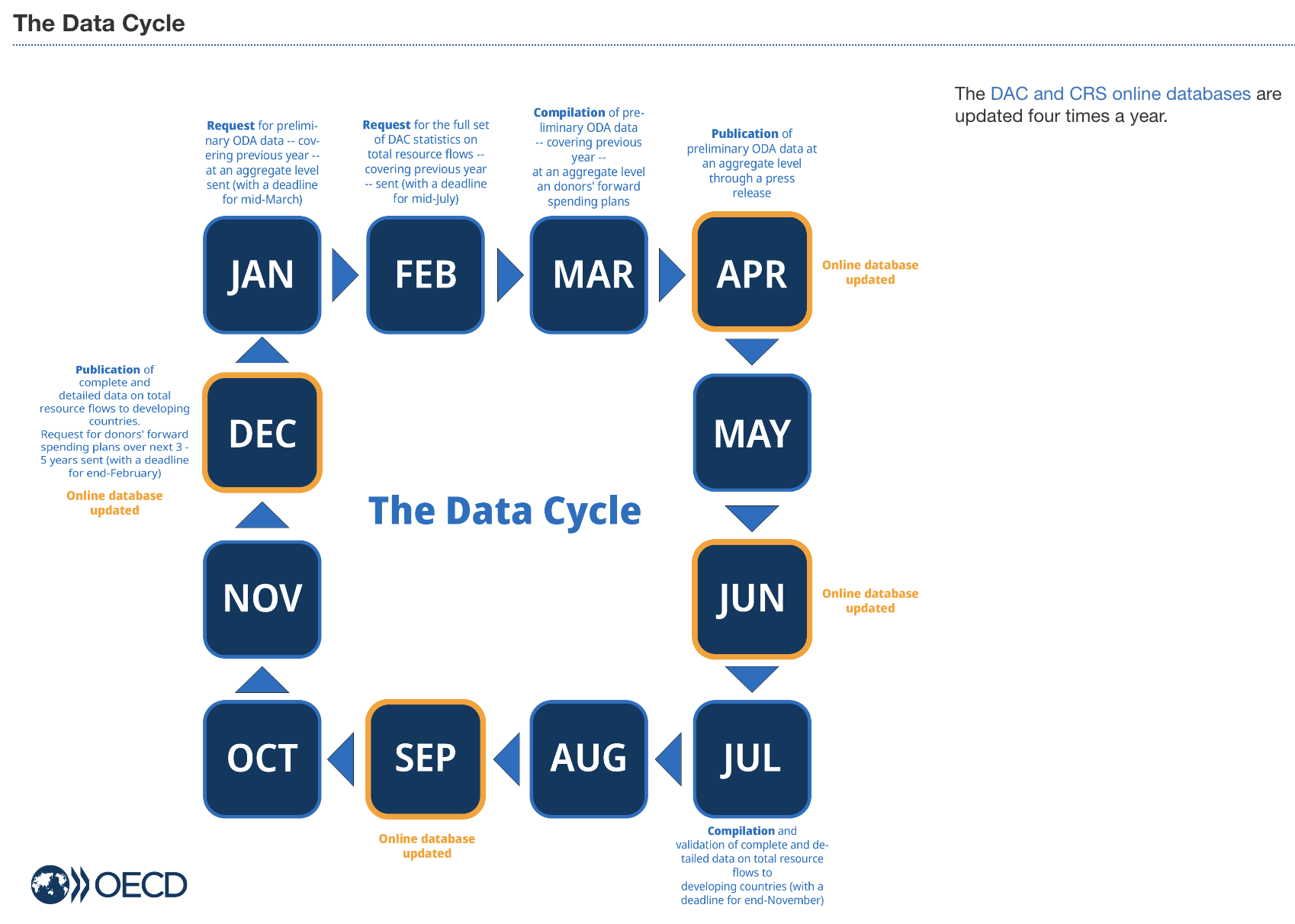
Official development assistance (ODA) is government aid that promotes and specifically targets the economic development and welfare of developing countries. ODA has been the main source of financing for development aid since it was adopted by the OECD’s Development Assistance Committee (DAC) as the “gold standard” of foreign aid in 1969. The OECD is the only official source of reliable, comparable, and complete statistics on ODA.
1. Preliminary 2023 ODA statistics
2. How is ODA data collected?
Data collection and resources for data reporters
Development finance data are collected using a converged reporting system whereby bilateral and multilateral providers of development co-operation use a single file format (Creditor Reporting System – CRS) to report at item level on all flows of resources to developing countries. Item-level reporting is validated against key aggregates also reported by donors and then serves as the basis for producing various other aggregate statistics.
8. Sustainable Development Goals (SDGs)
The 2030 Agenda for Sustainable Development sets out 17 Sustainable Development Goals, with concrete targets like ending child marriage everywhere, or ensuring everyone has access to affordable and reliable electricity. These goals are universal, meaning that all countries have committed to strive towards them. They aim to improve people’s lives all over the world, foster prosperity and protect the planet. To support this global endeavor, the OECD helps countries devise strategies, strengthen governance frameworks and measure progress towards achieving the Goals.
1. Mesuring distance to SDGs
The 17 UN Sustainable Development Goals (SDGs) incorporate 169 targets. National strategies to hit the targets need reliable data to structure approaches and commit resources efficiently. OECD work on Measuring Distance to the SDG Targets provides a high-level overview of strengths and weaknesses in national performance, helping countries navigate the SDGs’ complexity and identify priorities.
2. The SDG Communicator Platform
Key messages
Achieving the SDGs requires governments to take a systemic approach and strengthen their capacities and governance frameworks to enhance policy coherence for sustainable development
Each Goal influences many or even all of the others. For example, investing in health has benefits for education and employment opportunities. Relatedly, government policies in different sectors can create positive feedbacks and synergies, but they can also have unintended, negative consequences that cut across different sectors and even extend beyond national boundaries. To address this, the OECD has formulated a set of eight principles aiming at enhancing “policy coherence for sustainable development”.
With thwe right quidance and incentives, the global financial system can finance the SDGs
Before the COVID-19 crisis, the SDG financing gap for developing countries was over USD 2.5 trillion. That has now risen to over USD 4 trillion because of the need to offset the economic impact of the pandemic coupled with a downturn in private investment. The OECD points out that this still represents only around 1 percent of global financial assets, and calls on governments and other public and private stakeholders to better orient those resources to the regions and communities that need them the most.
Every country will have to make a significant effort to achieve the SDGs
We are only few years away from 2030, the SDGs target year, but OECD and other economies still have some way to go to meet their SDG commitments. Objectively identifying what has been achieved and what remains to be done can help to focus thinking and guide decisions on the most effective courses of action. The OECD has developed a tool to enable its members to measure the distance to the SDG targets. It reveals mixed results: the OECD area as a whole is close to securing basic needs, but implementing the SDGs in a coherent way to achieve social and environmental goals remains a major challenge for most countries.
Engaging citizens and stakeholders to achieve the SDGs
Moving forward on the SDGs requires a whole-of-society approach, with citizens and stakeholders supporting SDG policies and participating in their achievement. Good communications can help build trust in institutions working to achieve the Goals. It can increase awareness and mobilise action, for example by promoting climate-friendly behaviours, positive attitudes to gender equality and increasing investments into sustainable development. The OECD Development Communication Network (DevCom) promotes peer learning on how to engage citizens and stakeholders for the SDGs.
9. Tax and development
Effective taxation is vital for development. An effective tax system not only raises revenues needed for funding public services, but can also support development goals, for example by helping combat illicit financial flows, reducing inequality through redistribution and addressing health and environmental objectives by influencing taxpayer behaviour.
1. TIWB Annual Report 2024
Tax Inspectors Without Borders Annual Report 2024
This report looks back at TIWB’s achievements from July 2022 to December 2023. Chapter 1 describes TIWB in the evolving international taxation and development context. Chapter 2 discusses TIWB programmes and operations. Chapter 3 provides information on current and future areas of TIWB technical assistance. Chapter 4 highlights results obtained over the past year. Chapter 5 describes TIWB participation at international events and the initiative’s communication efforts. Finally, Chapter 6 sets out the work plan for the year and provides an overview of the previous year’s objectives and performance.
2. Tax and Development at the OECD: A Retrospective (2009-2024)
This report looks back at 15 years of tax and development work at the OECD charting the evolution of the OECD’s engagement with, and inclusion of, developing countries in its tax work from 2009 to 2024. Beginning with the restructuring of the Global Forum on Transparency and Exchange of Information for Tax Purposes in 2009, through the BEPS Actions, the establishment of the Inclusive Framework on BEPS and negotiations on the Two Pillar Solution to Address the Tax Challenges of the Digitalising Economy, it shows how OECD initiatives have combined the momentum for multilateral tax co-operation with the increased focus on taxation in international development, to develop a range of tools, instruments and forums with wide participation from developing counties. Accompanying the move to multilateralism in tax matters, the OECD has also sought to increase the availability of data on taxation, for example through the Global Revenue Statistics Database, and support more integrated tax and development policy thinking, for example on the taxation of development assistance. Concurrently there has been a continuous growth in the OECD capacity building activities, now reaching over 30,000 officials in over 100 countries annually. Notable among these initiatives is the groundbreaking joint OECD/UNDP Tax Inspectors Without Borders initiative. The report features several case studies highlighting the impacts across various countries, as well as the wide range of partnerships forged by the OECD to harness taxation’s potential in advancing sustainable development.
10. Urbanisation, infrastructure and development
Fast-growing cities are transforming the economic, social and political landscapes. This is especially evident in Africa where urbanisation offer significant opportunities to accelerate progress towards the 2030 and 2063 development agendas. The OECD provides vital data and policy analysis to assist decision makers in comprehending the impacts of urban growth.
1. Africapolis urban data platform
2. Intermediary Cities and Climate Change
The consequences of climate change in developing countries are worsening fast: many ecosystems will shortly reach points of irreversible damage, and socio-economic costs will continue to rise. To alleviate the future impacts on populations and economies, policy makers are looking for the spaces where they can make the greatest difference. This report argues that intermediary cities in developing countries are such spaces. Indeed, in the context of fast population growth and urbanisation, these small and medium-sized cities silently play an essential role in the rapid transformation of human settlements, not least by supporting the massive flows of population, goods and services between rural and metropolitan areas. Most of those intermediary cities are still growing: now is therefore the time to influence their dynamics, and thereby the entire design of urbanisation in those regions, in ways that limit the exposure of urban dwellers to climate shocks and avoid carbon lock-in. To that end, based on fresh evidence and policy analysis on the challenges faced by these agglomerations in the context of climate change, the report makes the case for new development approaches to avoid the unsustainable paths followed by too many cities in the recent past.
Key messages
Cities deliver better economic outcomes and higher standards of living
Africa's urban share increased from 27% in 1990 to 54% in 2020. Cities drive economic development, increase resilience and address sustainability challenges. Urbanisation has contributed approximately 30% of Africa's GDP per capita growth over the past two decades. Small cities consistently outperform rural areas in terms of wages, skilled employment, educational attainment, and access to services and infrastructure, underscoring the economic advantage and improved living standards that urban environments bring.
Cities play a pivotal role in climate adaptation and sustainability
Recognising the strategic role of cities in national development agendas is essential to unlocking their full potential to drive growth and address climate adaptation. Positioned at the forefront of the response to climate change, African cities must prioritise green spaces to enhance ecosystem services and resilience and promote sustainability amidst rapid urban growth.
Now is the time to invest in fast growing, intermediary cities
In the context of fast population growth and urbanisation, small and medium-sized cities silently play an essential role in the rapid transformation of human settlements, not least by supporting the massive flows of population, goods and services between rural and metropolitan areas. Most of those intermediary cities are still growing: now is therefore the time to influence their dynamics, and thereby the entire design of urbanisation in those regions, in ways that limit the exposure of urban dwellers to climate shocks and avoid carbon lock-in.
'▪ Research' 카테고리의 다른 글
| Guide: Converting KOICA OpenAPI Data to Files Using Python (1) (0) | 2024.08.07 |
|---|---|
| [OECD Topics] Regional, rural, and urban development (0) | 2024.08.03 |
| [OECD Topics] Digital (0) | 2024.08.03 |
| Getting Started with Open API (3) (2) | 2024.08.01 |
| Getting Started with Open API (2) (0) | 2024.08.01 |


