
The OECD helps all subnational regions to become more equitable, inclusive and resilient by prioritising well-being. Our work addresses global trends like climate change, digitalisation, migration, jobs and demographic shifts by applying a local lens. Using a place-based approach and OECD regional data, we help improve lives for people, places and firms at the local level.
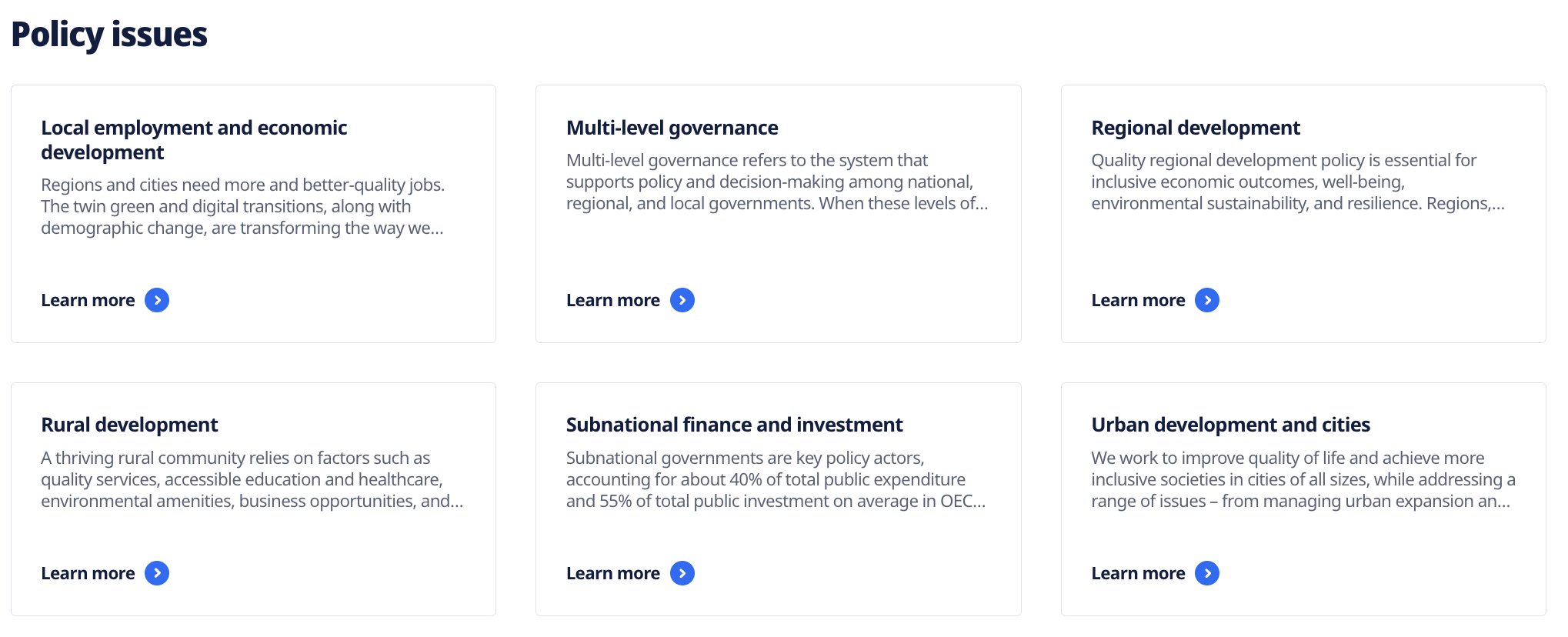
1. Local employment and economic development
Regions and cities need more and better-quality jobs. The twin green and digital transitions, along with demographic change, are transforming the way we work and redefining local economies and communities. Seizing new opportunities and responding to these changes demands innovative solutions, support for small businesses, and investment in communities, alongside efforts to upskill the workforce to better match job demands. The OECD provides expertise in developing and implementing policies and local initiatives aimed at creating more and better jobs leading to tangible results for local economic development.
1. Local Employment and Economic Development Programme (LEED)
2. OECD Local Development Forum
2. Multi-level governance
Multi-level governance refers to the system that supports policy and decision-making among national, regional, and local governments. When these levels of government work well together, policies are more likely to succeed, fostering development in all places. The OECD actively supports effective decentralisation and regionalisation reforms, as well as the strategic planning, implementation and performance measurement of regional policies at all levels of government.
1. Decentralisation
Decentralisation is among the most significant reforms of the past 50 years. It refers to the transfer of powers, responsibilities, and resources from the central government to elected authorities at the subnational level, with some degree of autonomy. Decentralisation covers three distinct but interrelated dimensions: political, administrative, and fiscal decentralisation. Finding the right balance among these dimensions and the right sequencing to implement them represent significant challenges in designing and implementing decentralisation reforms. The upscaling of subnational governance often accompanies decentralisation through inter-municipal cooperation, metropolitan governance, and regionalisation.
Related Publications : Making Decentralisation Work
This report offers a comprehensive overview of decentralisation policies and reforms in OECD countries and beyond. Sometimes called a “silent” or “quiet” revolution, decentralisation is among the most important reforms of the past 50 years. The report argues that decentralisation outcomes – in terms of democracy, efficiency, accountability, regional and local development – depend greatly on the way it is designed and implemented. Making the most of decentralisation systems is particularly crucial in the context of a “geography of discontent” and growing divides between places that feel left behind by globalisation and technological change and those that may benefit from the opportunities offered by megatrends. The report identifies 10 guidelines for making decentralisation work and allowing it to be conducive to regional development. Beyond the guidelines, the report proposes concrete tools for policy-makers, including detailed sets of recommendations, checklists, pitfalls to avoid and examples of good practices, both in unitary and federal countries.
2. Strategic planning and regional development
We help governments enhance multi-level governance, strategic planning, and policy implementation for regional development. Our aim is to help national, regional, and local governments promote inclusive economic growth and improve resident well-being. We provide all levels of government with concrete recommendations and capacity building tools to help them define long-term objectives, co-ordinate and co-operate with a broad range of stakeholders, and effectively deliver and monitor policies for regional development, innovation, and public services.
3. Regional development
Quality regional development policy is essential for inclusive economic outcomes, well-being, environmental sustainability, and resilience. Regions, cities and rural areas play a crucial role in responding to megatrends including climate change, digitalisation, demographic shifts, and globalisation, which have very different effects within OECD countries. At the same time, regions within OECD countries vary widely in their social and economic structure, performance, and well-being. This diversity calls for a place-based approach to regional development, tailored to the needs and assets of each area.
1. OECD Regional Outlook 2023
Over the last two decades, regional inequalities have remained significant, and have grown within many OECD countries. Impacts of recent shocks, including the COVID-19 pandemic and Russia’s war of aggression against Ukraine, and megatrends, threaten to widen these gaps between regions, deepening the longstanding geography of inequalities. This report, Regional Outlook 2023 – The Longstanding Geography of Inequalities, provides novel evidence on the evolution of inequalities between OECD regions across several dimensions (including income and access to services) over the past twenty years. It sheds light on the role of productivity to address regional inequalities. It also looks at the costs of regional inequalities, which can weaken the economic, social, and political fabric, and lead to a geography of discontent. Furthermore, the report explores forward-looking scenarios for regions as part of ongoing reflections to future-proof regional development policy and secure social cohesion. Finally, it provides a policy roadmap to guide governments’ efforts to reduce persistent regional inequalities now and in the future.
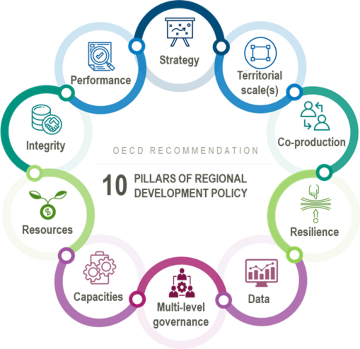
2. OECD Recommendation on Regional Development Policy
The OECD Council, recognizing the importance of regional development policies, has adopted a comprehensive framework to address regional inequalities and promote sustainable development. The Recommendation emphasizes the need for place-based policies tailored to the specific needs of regions, incorporating multi-level governance, and engaging local communities and stakeholders. It highlights the role of regions in national economic performance, well-being, and environmental sustainability, and the need for integrated strategies to address global megatrends like climate change and digitalization. The framework outlines ten pillars, including strategic regional development, appropriate territorial targeting, resilience building, and performance management. This initiative aims to ensure coherent, inclusive, and effective regional development policies, leveraging local knowledge and capacities to foster national and global progress. The RDPC will support implementation through a detailed toolkit and ongoing monitoring to maintain the framework's relevance.
4. Rural development
A thriving rural community relies on factors such as quality services, accessible education and healthcare, environmental amenities, business opportunities, and strong social trust. The OECD analyzes and adapts policies, working closely with member countries, to address diverse rural challenges, to strengthen economies and support inhabitants while guiding governments in implementing effective rural development policies.
1. Rural Well-being: Geography of Opportunities
Rural Well-being: Geography of Opportunities presents the latest iteration on this policy framework, reflecting several important changes in rural development in recent years. Fully taking into account the variety of situations characterising rural regions, the new policy framework leverages improved data and analysis while broadening the scope from economic focus to encompass the environmental and social dimensions of well-being. The new approach places the well-being of citizens at the forefront of its objective and recognises the diversity of rural places brought by a deeper understanding of their diverse and complex socio-economic systems and their connection to cities. The framework also looks to the future and unfolding megatrends such as globalisation, digitalisation, climate change and demographic change. It reflects on how these will impact rural economies and reviews policy options to mitigate the challenges and capitalise on opportunities as well as to develop resilience against emerging crises. Finally, recognising the strong interdependencies between different stakeholders and the need for partnerships between government, the private sector and civil society to successfully implement policies, the Rural Well-being Policy Framework focuses on governance mechanisms, including the OECD Principles on Rural Policy.
2. Unlocking Rural Innovation
In the midst of a global slowdown in productivity, unlocking the innovative potential of rural places is more important than ever. As part of a series on supporting to help rural areas thrive, this thematic report provides the latest analysis and research on rural innovation, and proposes ways to overcome the growing gaps between rural and urban places that are contributing to the geographies of discontent. It first explores the multi-facetted innovative practices that are already occurring in rural places, and proposes alternative indicators beyond the traditional science and technology measures to capture them. Then, it identifies policy drivers and bottlenecks to help rural entrepreneurs, firms and people fully mobilise their growth potential. Results and recommendations are drawn from research and fact-finding missions from select OECD member countries.
5. Subnational finance and investment
Subnational governments are key policy actors, accounting for about 40% of total public expenditure and 55% of total public investment on average in OECD countries. Subnational governments are also key public employers, representing more than 60% of public staff expenditure on average in the OECD.
Public investment and infrastructure
Subnational governments - states, regions, and municipalities – play a key role in public investment, particularly in key infrastructure projects essential for economic development and well-being. Across the OECD, subnational governments account for nearly 60% of total public investment on average. When well-managed, public investment is a catalyst for the growth and development of regions and cities. A place-based approach to investment with effective multi-level governance systems enables countries to maximise investment returns and support regional development.
6. Urban development and cities
We work to improve quality of life and achieve more inclusive societies in cities of all sizes, while addressing a range of issues – from managing urban expansion and encouraging innovation to driving the digital, climate and demographic transitions.
1. Decarbonising Buildings in Cities and Regions
Accounting for nearly 40% of global energy-related CO2 emissions and sometimes as much as 70% in large cities, buildings and construction are central to the low-carbon transition. Decarbonising buildings, especially the old stock, through energy efficiency improvements and renewable energy use, not only reduces carbon emissions, but also generates co-benefits in health, energy affordability and the labour market. Additionally, global mega-trends and the transition to a green recovery from COVID-19 provide impetus for stakeholders to take action. Cities and regions have a key role to play and can leverage prerogatives in regulation, public procurement and stakeholder engagement, while addressing multiple governance, capacity and funding gaps. To accelerate and scale up their action, cities and regions need to work with national governments to create an effective governance mechanism. Drawing on the findings of a dedicated survey of cities and regions of all sizes from both OECD and non-OECD countries, this report explains their significant role, explores sub-national policy measures, identifies key obstacles, and provides policy recommendations and a checklist for both national and subnational governments to drive the decarbonisation of buildings in cities and regions.
2. A Territorial Approach to Climate Action and Resilience
Global warming is likely to reach 1.5°C as early as in 2030, with current climate action falling short of meeting the Paris Agreement goals and a mounting risk of tipping beyond the ability of human societies to adapt. Building on broader OECD work on climate, this report proposes a new OECD territorial climate indicator framework and demonstrates that the potential to mitigate greenhouse gas emissions, adapt to climate impacts and address vulnerabilities varies across different territories. The report also presents a policy framework of 9 recommended actions to help decision makers unleash more effective climate action and resilience, both by integrating a territorial approach into national and subnational climate policies and by mainstreaming climate objectives into urban, rural and regional policies. The report summarises the analysis into a checklist for national and local governments to implement a territorial approach to climate and resilience policies, as well as a compendium of 36 best practices from cities, regions and countries from all around the world.
Key messages
Leveraging the OECD Principles on Urban Policy to shape the cities of tomorrow
The OECD Principles on Urban Policy aim to guide policymakers in building smart, sustainable, inclusive and resilient cities of all sizes. The Implementation Toolkit of the OECD Principles on Urban Policy offers a self-assessment tool and best practices from around the world to help governments at all levels deploy the Principles as an accelerator of policy reform.
Deep dives in urban policy
The OECD is supporting cities, regions and national governments in all areas of urban policy, ranging from navigating the climate, digital and demographic transitions to improving the urban built environment (e.g. housing, transport) and reducing inequalities.
Join the OECD policy networks on urban policy
The OECD is bringing together leaders, policymakers and stakeholders to share the latest evidence and promote innovative practices on urban policy. Such policy networks include the OECD Working Party on Urban Policy (closed-door sessions twice a year, with representatives officially nominated by member countries), the OECD Champion Mayors for Inclusive Growth, the OECD Roundtable of Mayors and Ministers, and OECD thematic roundtables on cities and regions for the SDGs, the circular economy, and smart cities, among others.
'▪ Research' 카테고리의 다른 글
| Guide: Converting KOICA OpenAPI Data to Files Using Python (2) (0) | 2024.08.08 |
|---|---|
| Guide: Converting KOICA OpenAPI Data to Files Using Python (1) (0) | 2024.08.07 |
| [OECD Topics] Development (0) | 2024.08.03 |
| [OECD Topics] Digital (0) | 2024.08.03 |
| Getting Started with Open API (3) (2) | 2024.08.01 |


