
OECD Open Government Data project - Methodology
The methodology was first put forward in the Working Paper Open Government Data: Towards Empirical Analysis of Open Government Data Initiatives, and is being validated in collaboration with government representatives from OECD countries as well as non-government stakeholders.
Towards Empirical Analysis of OGD Initiatives
Ubaldi, OECD, 2013
What is Open Government Data (OGD)
Background
- Open Government Data (OGD) is a philosophy- and increasingly a set of policies - that promotes transparency, accountability and value creation by making government data available to all. Public bodies produce and commission huge quantities of data and information. By making their datasets available, public institutions become more transparent and accountable to citizens. By encouraging the use, reuse and free distribution of datasets, governments promote business creation and innovative, citizen-centric services.
- Many public organizations produce and collect a broad range of different types of data in order to perform their tasks. The extraordinary quantity and centrality of data collected by governments make these data particularly significant as a resource for increased public transparency. OGD can be used to help the public better understand what the government does and how well it performs, and to hold it accountable for wrongdoing or unachieved results.
However, OGD still remains an uncharted territory.
There are two main civil society movements that are campaigning for greater openness of information, documents and datasets held by public bodies.
- The "Right to Information" movement, which promotes a public right of access to information from a human rights perspective.
- The "Open Government Data" movement, which uses predominantly social and economic arguments to encourage the opening up of government data. It claims that putting such information into the public domain can benefit society by creating conditions for more social inclusive service delivery and for more participatory democracy. It also argue that it can stimulate the economy by allowing the possibility for third parties (e.g. individuals, private enterprises, civil society organization) to create new products and services using public data.
There is significant overlap between both movements, in that both aim to increase the transparency of government so that all members of society can enjoy the inherent social and economic value of information that has been generated and collected with public funds.
Nevertheless, there are also differences in the approaches and strategies employed by each. One of the main differences is that right to information advocates place emphasis on access to qualitative as well as quantitative information, which is often stored in the form of documents, whereas open government data advocates focus on data that are held in government databases, and they are concerned with both the technical and the legal issues related to the access, use and re-use of these datasets.
Therefore, while the right to information movement has put an emphasis on the obligation of public bodies to respond to requests for information, the open government data movement emphasizes proactive release of large volumes of information in formats and under conditions that permit re-use.
Definitions
- Public Sector Information (PSI) is broadly defined as "information, including information products and services, generated, created, collected, processed, preserved, maintained, disseminated, or funded by or for a government or public institution," taking into account the legal requirements and restrictions.
- Open Government Data (OGD) contains the two main elements that are normally defined as (1) government data, which is any data and information produced or commissioned by public bodies, and (2) open data that can be freely used, re-used and distributed by anyone, only subject to (at the most) the requirement that users attribute the data and that they make their work available to be shared as well.
- Big Data is a collection of datasets so large and complex that it is difficult to use on-hand database management tools, or traditional data processing applications, for their processing that includes capturing, storage, search, sharing, transfer, analysis, and visualization.

While economic and social activities have long revolved around the use of data, the significant volume, velocity and variety of data increasingly being used across the economy, and the important social and economic value of this data, signal a shift towards a data-driven social-economic model, commonly referred to as "big data". In this model, data are a core asset for creating significant competitive advantages and for driving innovation, sustainable growth and development.
Principles
Eight Open Government Data Principles were defined and put forward for governments' considerations in 2007.

In 2011, the United States Federal Chief Information Officer Vivek Kundra identified ten principles for improving federal transparency in his testimony before the House Committee on Oversight and the Government Reform Subcommittee.
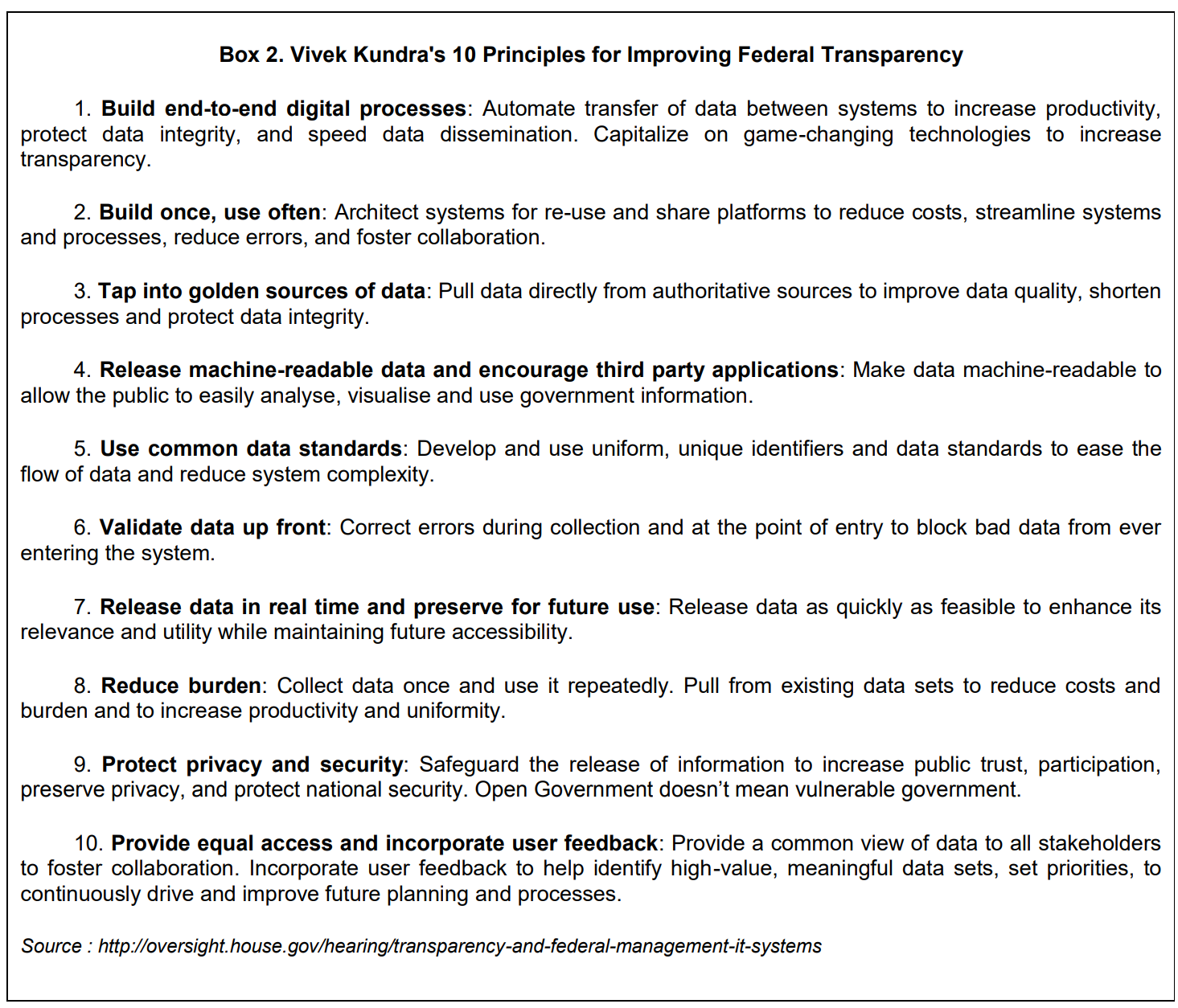
In 2012, the United Kingdom Public Sector Transparency Board published the Board's Public Data Principles that have been the foundation for guiding the public sector in publishing data.
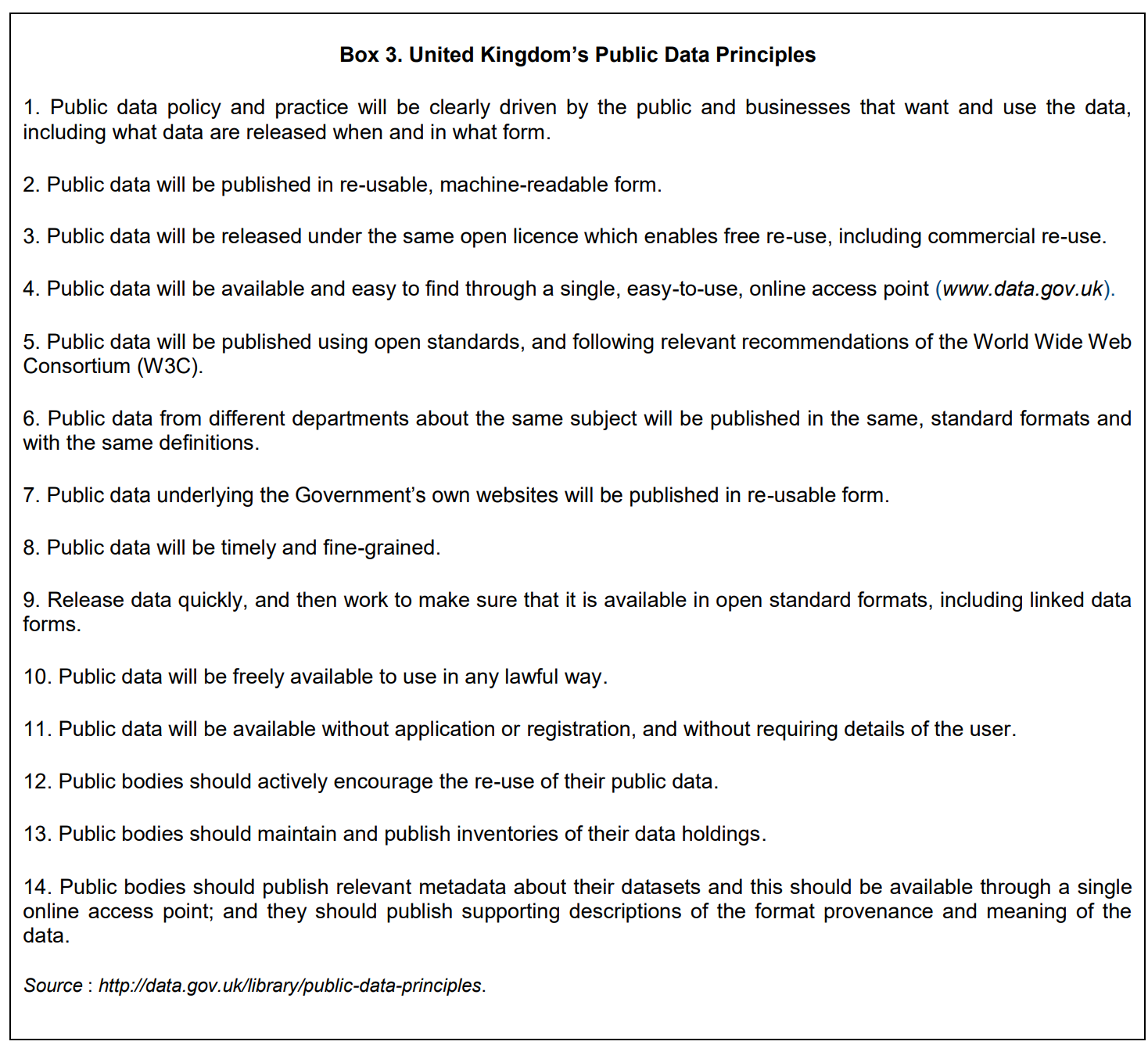
Beyond Access: What Value?
The main beneficiaries of the value being created
- Government : In order to improve the overall efficiency of government operations (e.g. accelerate efforts to reduce fraud and error, make further inroads into the tax gaps) and more effectively and efficiently deliver smarter, innovative and more personalized public services, while improving the quality of interactions between the governments and the users. OGD can equally enable an increase in transparency that can strengthen accountability. Additionally, by being more open, governments gain in terms of legitimacy vis-a-vis citizens and civil society.
- Citizens : Open government data are expected to enable public participation and social engagement in designing responses to public needs (e.g. co-development and co-production of services through newly developed apps); and to allow the sourcing information and knowledge from more diverse sources (e.g. crowd sourcing). Opening up public sector data (e.g. crime rates, gas emissions, teachers per student in city schools) is geared also towards allowing citizens to make more informed personal choices.
- Civil Society : Civil society initiatives that build on OGD can be found across many OECD member countries. The shared goals of these initiatives include demonstrating the benefits of OGD to government and to the public. However, there is fragmentation in terms of specifically targeted goals that range from increasing transparency to improving service delivery - particularly for vulnerable segments of the population - to protecting the environment or sustaining growth. Additionally, civil society organizations can play a pivotal role as intermediaries in the identification of key datasets that, if open, could produce high value.
What value?
- Improving government accountability, transparency, responsiveness and democratic control
- Promoting citizens self-empowerment, social participation and engagement
- Building the next generation of empowered civil servants
- Fostering innovation, efficiency and effectiveness in government services
- Creating value for the wider economy
Notes:
- Strong supporters of OGD argue that it is a key enabler of Open Government, promoting transparency and public accountability. OGD can be a powerful force for public accountability by making existing information easier to analyze, process and combine, allowing for a new level of public scrutiny. This can raise the level of public trust and perceived responsiveness of government actions. The Open government Declaration is considered to have situated the use of ICTs, and new technologies in particular, to spur data sharing in the context of political accountability, thus blurring the distinction between the technology of open data and the politics of open government. However, it is important to underline that open government and OGD can each exist without the other, and increased transparency is not an automatic driver of greater accountability.
- OGD enables individuals to make better decisions in their lives and increases participation in public affairs. E-participation is part of a government's broader e-government policy aiming at harnessing IT use for openness, transparency and collaboration within the public sector, but also to increase citizen engagement in public life, e.g. in policy making and service design and delivery. The expanding use of new technologies, combines with the emergence of the OGD movement, are becoming key enablers and drivers of citizen self-empowerment, higher e-participation and public engagement.
- Equally important to empowering citizens is empowering the public sector workforce. Opening up government data can enable civil servants, many o
fwhom are frontline professionals, to participate directly in ensuring that government is open and participative, and to develop applicants that better respond to users' needs. Moreover, many civil servants also see a blurring of their personal and professional lives in terms of the tools they use.
- OGD has the potential to increase government efficiency, effectiveness and innovation in service delivery and internal public sector operations. Even though the release of government data online can raise a number of substantive enquiries in terms of government activities that require time to be addressed, from a service delivery perspective data re-use can also lead to a significant decrease of the questions routinely received by public authorities, or enable questions to be answered more quickly. Additionally, the remaining questions concerning service delivery per se would be easier for civil servants to answer as the relevant information would be easier to find. OGD can also help foster collaboration a cross and within public agencies and departments. Furthermore, as public resources are freed from having to maintain individual registers and datasets they can be reallocated to more productive tasks. Moreover, OGD provides a platform for innovative service delivery. This can not only result from the re-use of data by private sector actors or by civil society organizations, but also thanks to the re-use of data by civil servants, who have in several instances taken the initiative to develop new mobile application. The use of technology and data analytics within the public sector, and the integration of analysis in policy making and design of public service, can boost more integrated and innovative service delivery. Finally, improved service delivery can also emerge as a result of initiatives originally driven by a government's push for greater transparency around data.
- It is now widely considered that one important potential benefit of OGD is the income that can be generated by commercializing government data. (e.g. the overall market size for Public Sector Information) Recent economic analyses have additionally shown that when information is provided to the public free of charge or at very low cost, individuals, developers and private enterprises are more likely to take that information and create added-value products that they can then market. This can increase the volume of private sector activities which can stimulate the national economy and also provide revenue to the government in the form of taxes. In addition, data made available free of charge from public bodies can be used for civil society projects. This is particularly true for data that have broader potential value include mapping, meteorological, legal, traffic, financial, and economic data. Although the potential economic benefits which may emerge arise from OGD are evident, these are still estimates and there is little empirical data. Much still needs to be proven to show economic impact as OGD implementation is still relatively new and difficult to measure. Despite the challenges, it is essential to shed light on this aspect in order to assist governments in weighing investments against future benefits.
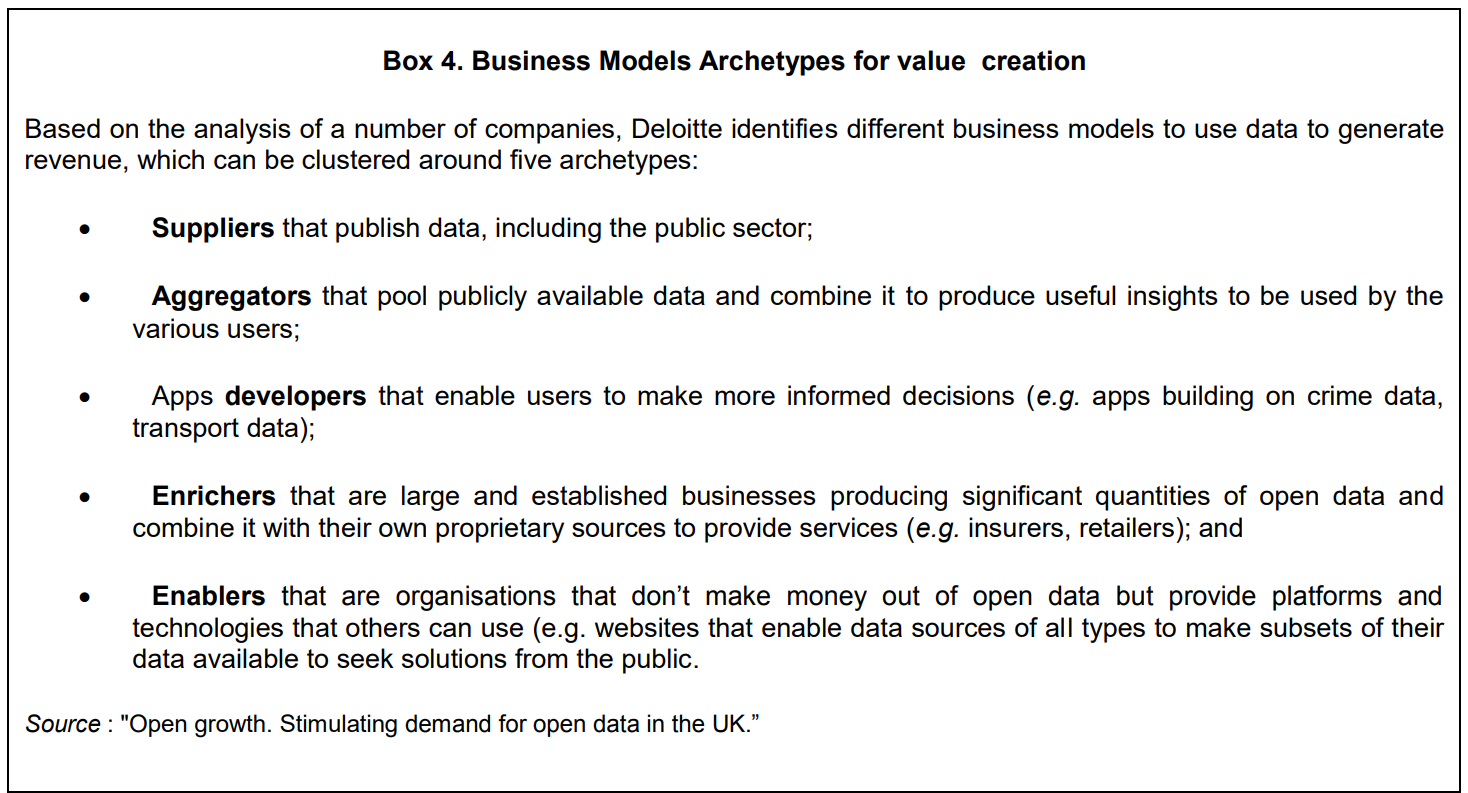
Understanding the value chain of open government data
Four main phases can be identified in the OGD value chain :
- Data generation
- Data collection, aggregation and processing
- Data distribution and delivery
- Final data use
Understanding prerequisites for data openness
Lee and Kwak (2011) recommend that the implementation of OGD initiatives should be incremental because each stage is important. The model presents four stages of implementation before government data is made fully open.
1. Stage Zero : Getting a view of what government data exists
2. Stage One : Increasing data transparency
3. Stage Two : Improving open participation
4. Stage Three : Enhancing open collaboration
5. Stage Four : Realizing ubiquitous engagement
At each of these stages, the level of engagement and participation increases as one progresses to the next stage. Fundamental to this model is data transparency as the essential stage for OGD; the other stages are dependent on available data in formats that enable the realization of the subsequent stages.
Progression from "data transparency" to "open participation" and "open collaboration"
Paving the way for value creation
In order to ensure that OGD actually creates value, the most important tasks facing governments appear to be:
- Identifying high-value, high-impact data for the public
- Improving and assuring data quality in terms of accuracy, consistency, and timeliness
- Fostering data demand and use by the various actors
Creating value out of OGD implies a good understanding of both data users' need - in terms of content and format. Different sets of data that have proven of great value if made open include :
- Public data (e.g. trade data, fiscal data, health data, education data, transport data, weather data, census data, map data/geographic data, crime data)
- Micro-statistic : data the state needs to function itself
- Performance data on government programs and spending (e.g. data on mortality for a doctor or in public hospitals)
- Personal data of public services' users
- Public cultural information
Understanding and fostering data use is critical to create value, as well as creating an ecosystem that supports a collaborative data creation process

Are data really open?
In order to be available and accessible, the entire data set must be offered, preferably for free (or at no more than a reasonable reproduction and distribution cost), and be downloadable over the internet.
- Data are easily accessible
- Data are available in a convenient and modifiable form
- Data are easy discoverable and findable
In order to ensure re-use and redistribution, the data must be provided under terms that permit re-use and redistribution including intermixing with other datasets.
- Data are in machine-readable format - as 'screen scraping' can be time consuming
- Data are released in open formats which are machine-readable.
- Data are available through bulk downloads
- Data are released in a timely fashion
- Data are linked
- Users have the right to re-use data without discrimination
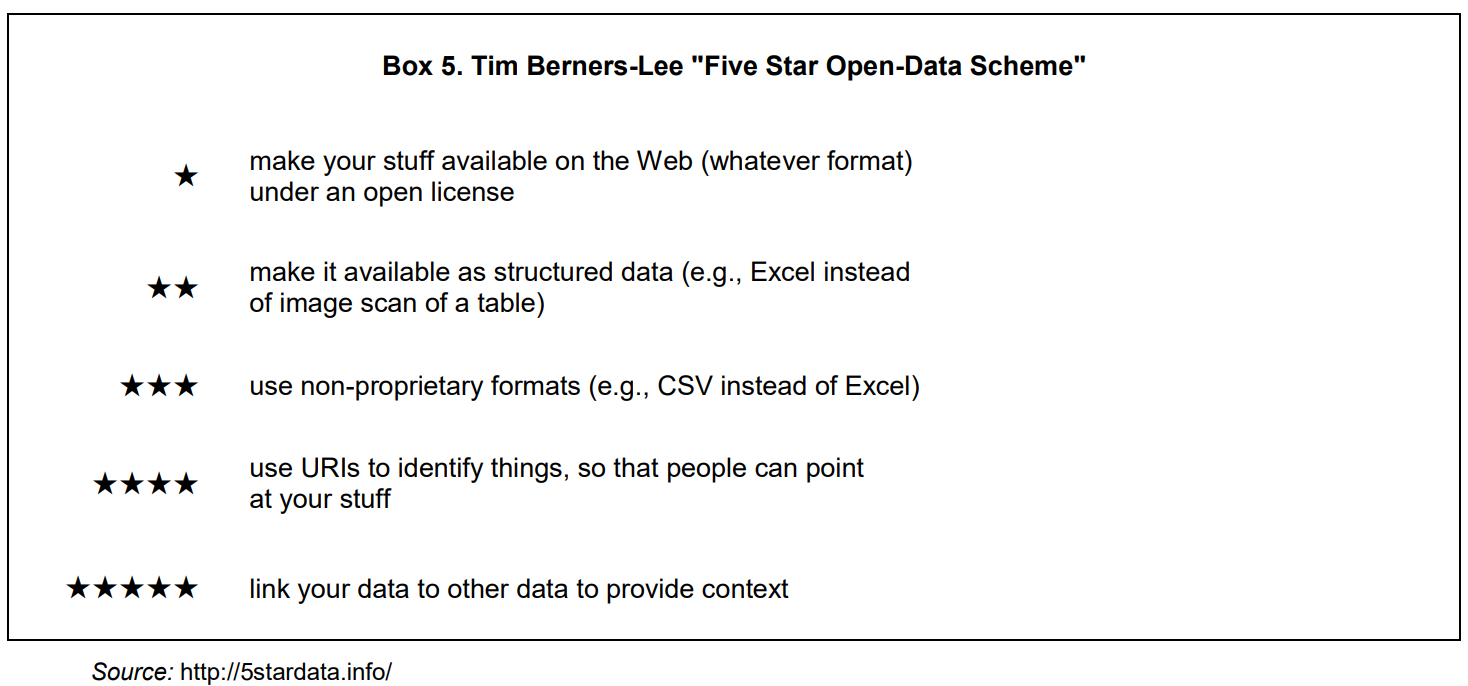
Re-usable data need to be available. The challenge is that often when data are available it is not in a format that enables re-use. Many times this data are shared in closed formats like PDF which does not enable re-use. In order to access the degree of dataset re-usability Tim Berners-Lee proposed a Five Star Scheme. In its "Open Data White Paper", the UK Government expressed its intention to adopt such a scheme as a measure of the usability of its Open Data.
Creating an Open Government Data ecosystem
Building an ecosystem that responds to specific demands asking for the provision of open government data are a necessity to create value out of OGD. The concept of ecosystem in this context applies specifically to the provision and use of Open Government Data. Establishing the right ecosystem is not so evident, but at least three categories of ecosystems can be identified.
- Ecosystem of data producers
- Ecosystem of infomediaries
- Ecosystem of users
Key dimensions for implementation
Policy challenges
- Disclosure policies, limit data transparency and copyrights may result in lack of clarify over who owns government data.
- An unresolved conflict between the right to access information as an inherent part of the right to freedom of expression, versus the limitation on re-use arising from copyrights and changes for commercial use.
- Although the vast majority of OECD member countries have engaged in the development of OGD initiatives, few have specific strategies and related policies.
Technical challenges
- Government data are often un-harmonized as every public agency has its own set of data, formats and standards. This can make it difficult from the user perspective to know which piece of data is valid or should be trusted.
- OGD value can also be limited if PSI cannot be re-used, and data transparency might be hindered if data are not simple to access due to its formats.
- An additional layer of challenges can emerge when the federal government seeks to impose coordination or consistency across the broad range of rulemaking processes, data and portals enabling access to government data.
- Interoperability remains an unresolved issue in e-government, and can potentially have an impact on OGD development.
Economic and financial challenges
- Collection and provision of data
- Converting large volumes of data into re-usable formats
- Posting full datasets in open source formats on government websites
- Designing a new data framework to assess costs and benefits of OGD
Organizational challenges
- Ensuring accountability, quality of data and responsibility in a context of collaboration
- Balancing autonomy and control
- Ensuring sustainable change through "ecosystems" of key actors
- Engaging with the wider community in a two-way conversation to build capacities and find agile solutions
- Revisiting internal processes to support data release workflows
Cultural challenges
- Increasing public interest and preparedness
- Recognizing the value of crowd sourcing
- Shifting the culture of the public sector, providing incentives and building new capabilities
- Ensuring the "buy in" of all stakeholders
Legal challenges
- The scope of right of access to information
- Legal exceptions to openness
- Complexities of the various national legal frameworks for copyright and related rights
- Legal requirements for Web masters
- Extent of flexibility in existing regimes
Next steps in the analysis
Overarching conceptual issues
- Bridging the distance between access to information and OGD movements
- Resolving the conflict between the right of access to information, as an inherent part of the right to freedom of expression, and versus the limitation on re-use arising from copyrights and charges for commercial use
- Adopting an Open Government data strategy
Addressing the emerging needs for governments and public at large
- Enhanced ability to combine different datasets together can help develop additional, more innovative and better products and services
- The value for good and participative governance to experiment and to be innovative
- Collective learning and collective intelligence
- Avoid creating new divides and inequalities and focus on user centricity and universal access.
- Enhanced access to data requires changes in the procurement and delivery of IT at the strategic level
- Understanding the context of data demand
- Grasping the value of open government data for the public sector
Addressing the emerging needs for governments and public at large
- Enhanced ability to combine different datasets together can help develop additional, more innovative and better products and services
- The value for good and participative governance to experiment and to be innovative
- Collective learning and collective intelligence
- Avoid creating new divides and inequalities and focus on user centricity and universal access
- Enhanced access to data requires changes in the procurement and delivery of IT at the strategic level
- Understanding the context of data demand
- Grasping the value of open government data for the public sector
Harmonizing definitions and sorting out legal "conflicts"
- Clearly defining terms and clarifying the relationship between data, information and knowledge and its implications is critical
- Striking the balance between transparency and privacy
- Building greater trust in public data and managing risks
- A further set of issues surround the relationship between the European Union's PSI Directive and access to information laws
- A potentially more serious problem is that government data re-use rules can set up a dual charging regime
Advancing empirical analysis and measurements
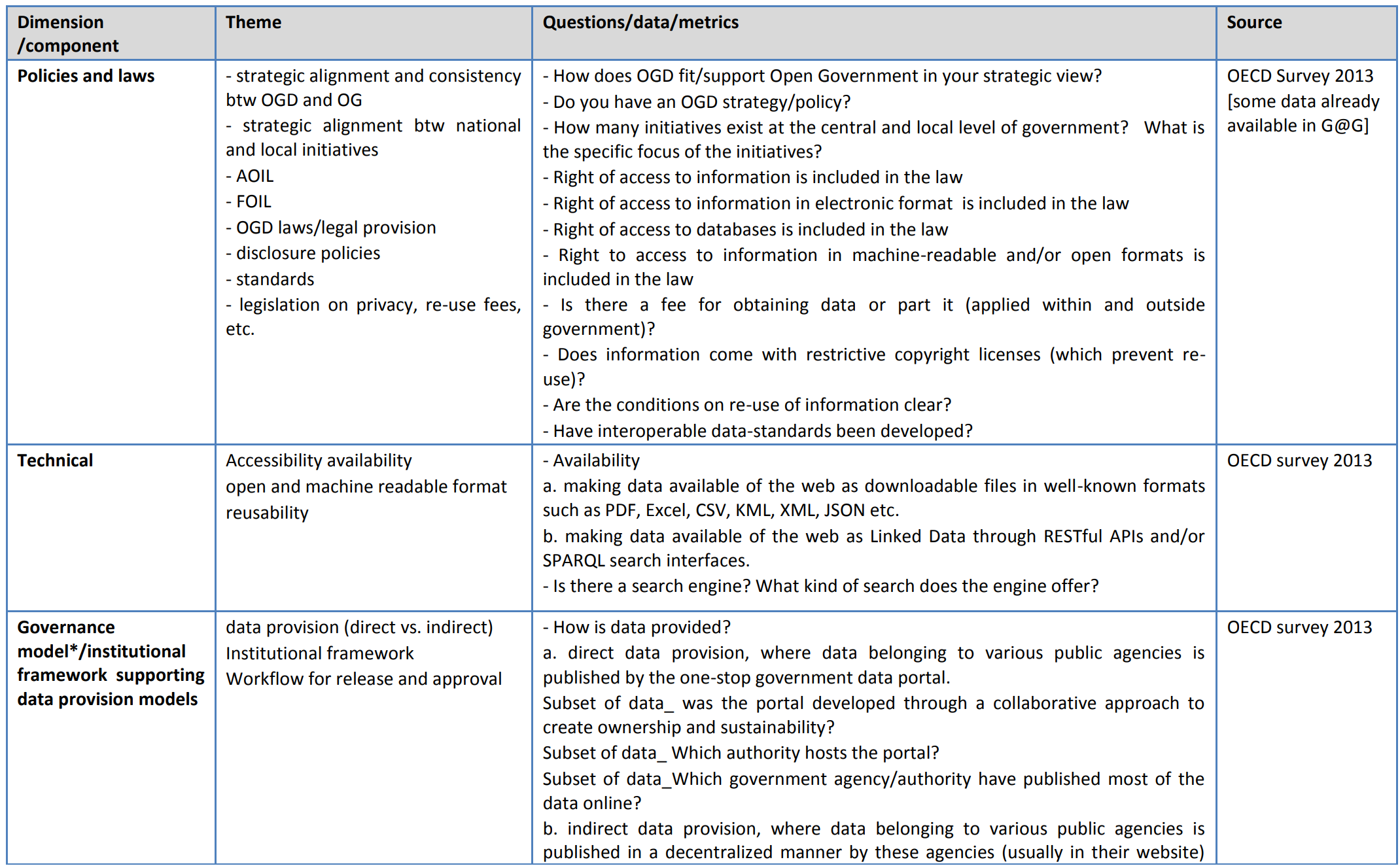
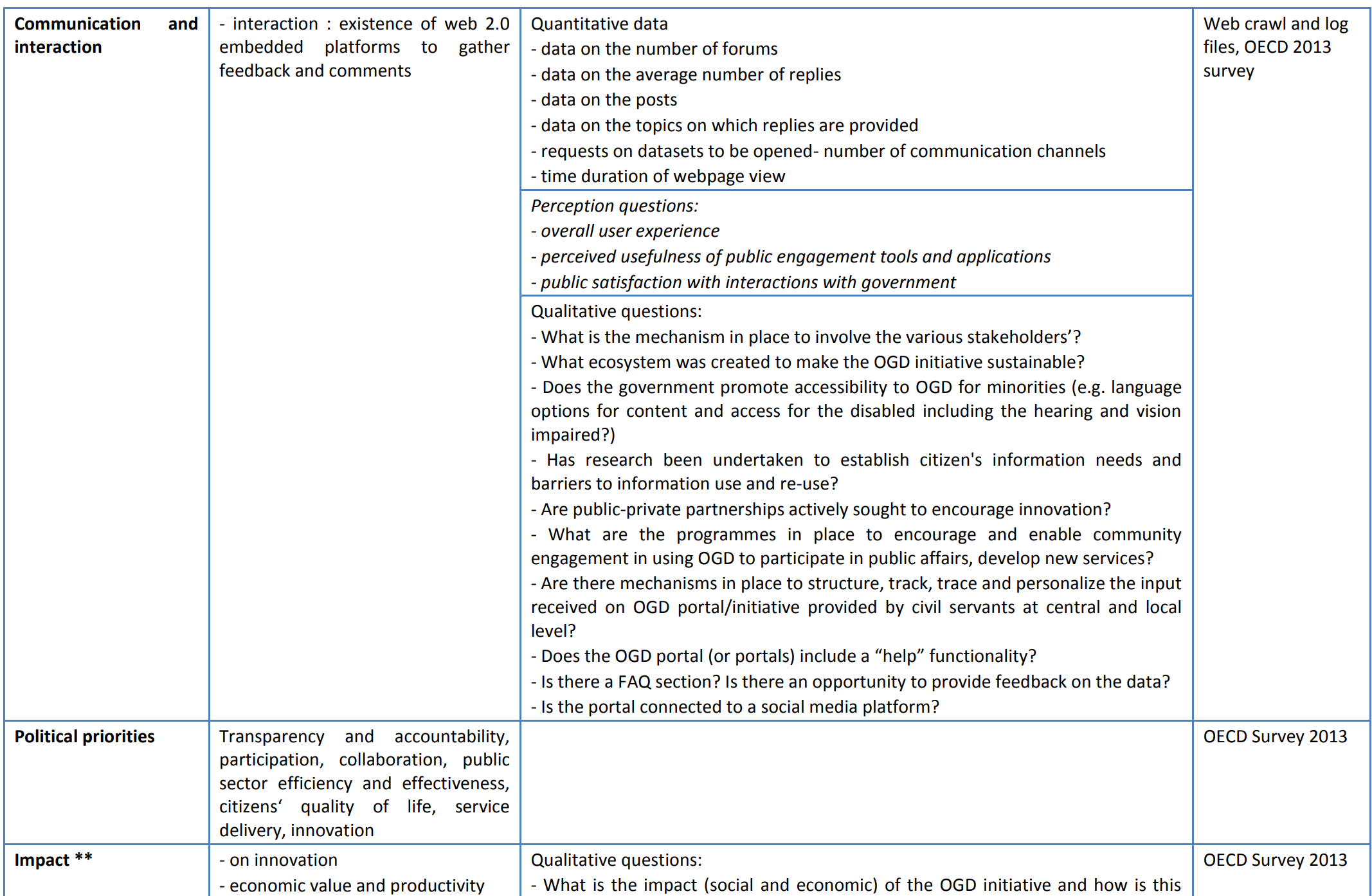
- Empirical analysis and measurements are pivotal to better understand and measure both cost and impact of OGD in wide social and economic terms, and with regards to political issues, in order to inform decisions around the design and implementation of OGD
- A good understanding of the relationship between the supply and use of OGD can allow a deeper evaluation of the OGD value chain
- Adopting solid "cost and benefit analysis" framework and clear business models to boost the desired impact and obtain the desired results
Enabling an empirical analysis
This section provides a suggestion for an analytical framework, and data collection as a complement, to gather key data on OGD Initiatives: supporting strategies, implementation frameworks and impact and value creation assessment. The analysis of background information collected through interviews and desk research, and structured around the main components of the Analytical Framework, to be completed by data collection, will enable the mapping of initiatives in OECD countries, identify typographies of initiatives and approaches and move towards a common understanding of what matters for outcomes and a unique methodology to understand correlations and underlying causes and thus assess the efficiency of implementation and achievements of impact. This exercise is ultimately expected to assist countries in keeping up the promise of open government data initiatives as a lever for public sector reform which requires their full scale implementation backed up by a comprehensive set of measures.
Table 1. Analytical framework for national (and sub-national) OGD portals and supporting initiatives
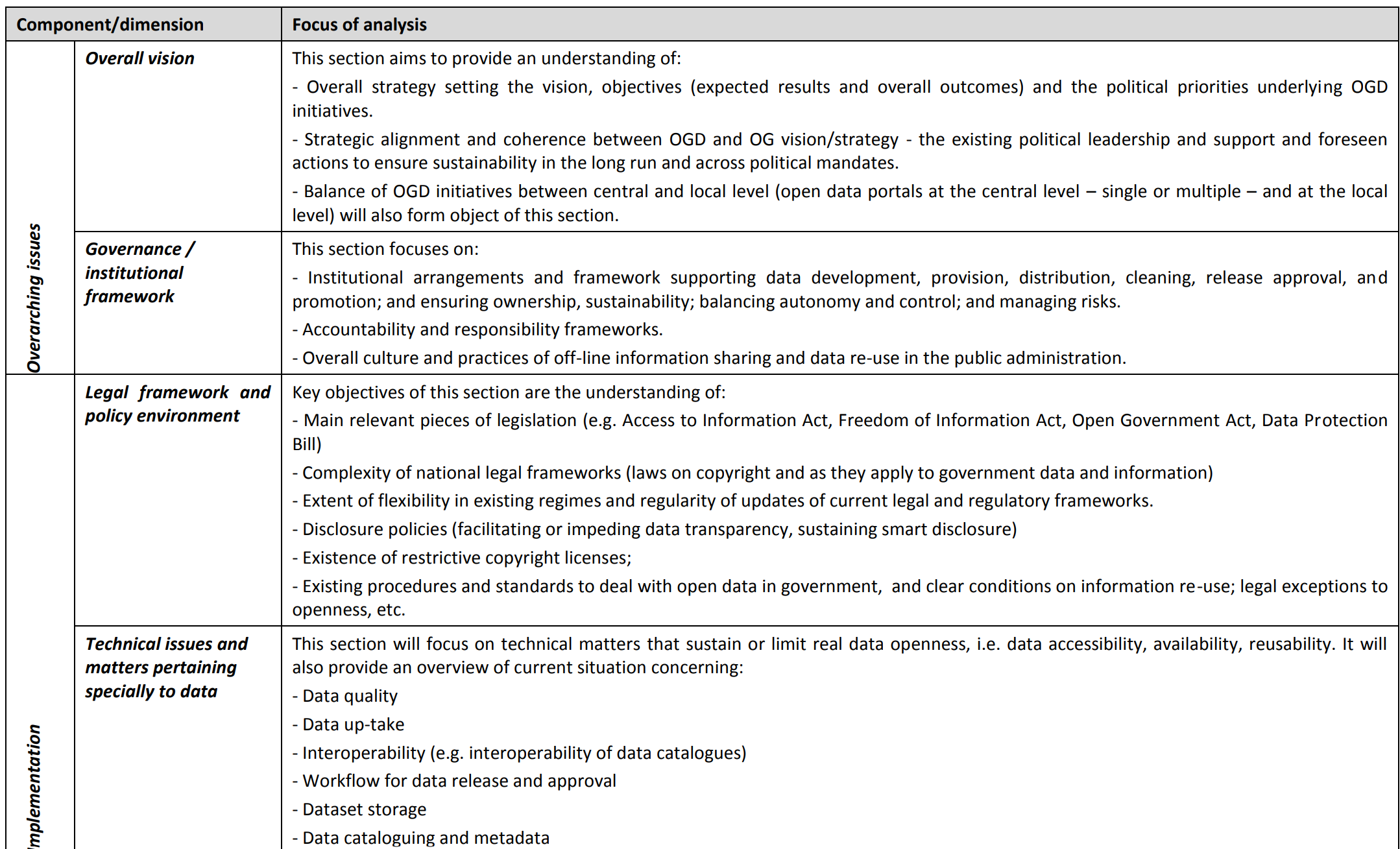
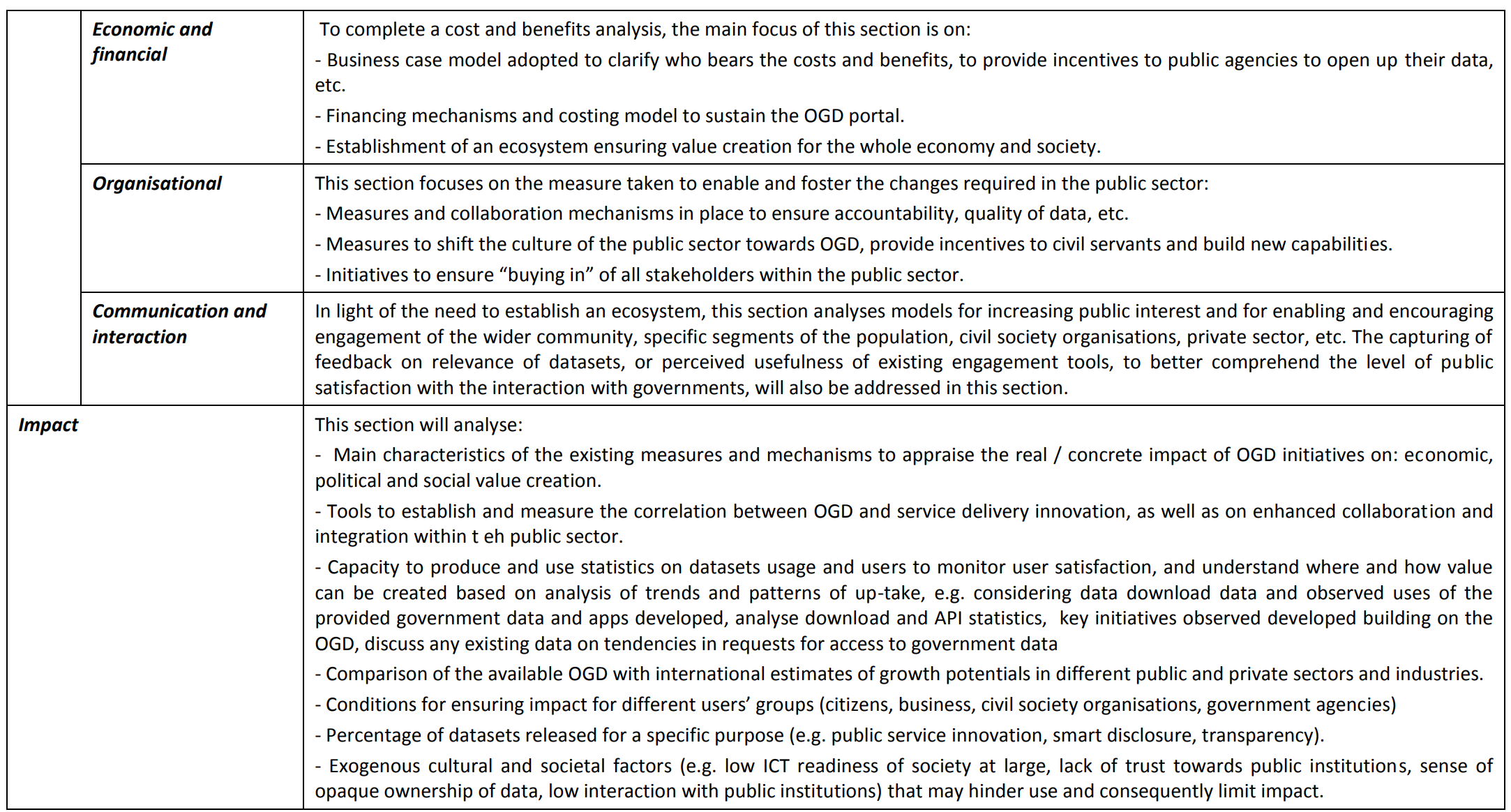
Table 2. Towards a set of metrics (indicators) on open government data



'▪ Research' 카테고리의 다른 글
| ODA 사업평가 환류체계: 평가와 성과 사이 (0) | 2024.07.24 |
|---|---|
| Getting Started with Open API (1) (5) | 2024.07.22 |
| Analysis of Recent Open Data Plans and Strategies in the US, UK, and Canada (0) | 2024.07.11 |
| 글로벌 개발협력에서의 민주적 거버넌스 강화: 실천과제와 방향성 (1) | 2024.07.10 |
| Open Government Data - Glossary of Terms (0) | 2024.07.08 |


