Water, Sanitation and Hygiene (WASH) : A Review of Methodologies
1. Evaluation of social-economic returns on investment among households beneficiaries of community-led-to-total sanitation in Busia County, Kenya
- Kenya government and UNICEF jointly implemented a pilot Community-Led-Total Sanitation Intervention (CLTSI) in Busia County to tame poor sanitation. The CLTSI was to achieve total sanitation among Busia County households through sanitation behavior change. To assure sustainability of sanitation behavior change, there was need to identify the specific attributable value of CLTSI to beneficiaries of Busia County. This study aimed at evaluating the social-economic returns on investment (SROI) among household beneficiaries of CLTSI in Busia County.
- Quasi Experimental Study design was used to collect data before (baseline) and after (outcome) for CLTSI implementation while multi stage-random sampling was used to same 459 households from villages that CLTSI had been implemented and certified to have achieved total sanitation in Busia County.
- The study has determined the social-economic value added (SROI = KES 1:10.5) that for every 1 KES (Kenyan Shilling) 1 invested, a social-economic value of KES 10.5 was added to residents of Busia County. This is a clear indication that CLTSI added social-economic value to the residents. The CLTSI is non-subsidies to sustainable sanitation behavioral changes. It has significant potential to empower many communities to improve the national coverage for sanitation and hygiene practices.
| Study Design | A quasi-experimental research design was adopted to collect data before and after the implementation of the National Total Sanitation Programme (NTSP) |
| Sampling | A multistage random sampling method was used to select 459 households from villages certified as having achieved total sanitation following the implementation of NTSP. |
| Data Collection | Structured questionnaires and observation checklists were utilized to assess household sanitation conditions and behavioral changes. |
| Analysis Method | The Social Return on Investment (SROI) methodology was applied to quantity the socio-economic benefits of NTSP in monetary terms |
| Conclusion | The study found that NTSP generated a social-economic return of 10.5 Kenyan Shillings (KES) for every 1 KES invested in the program. |
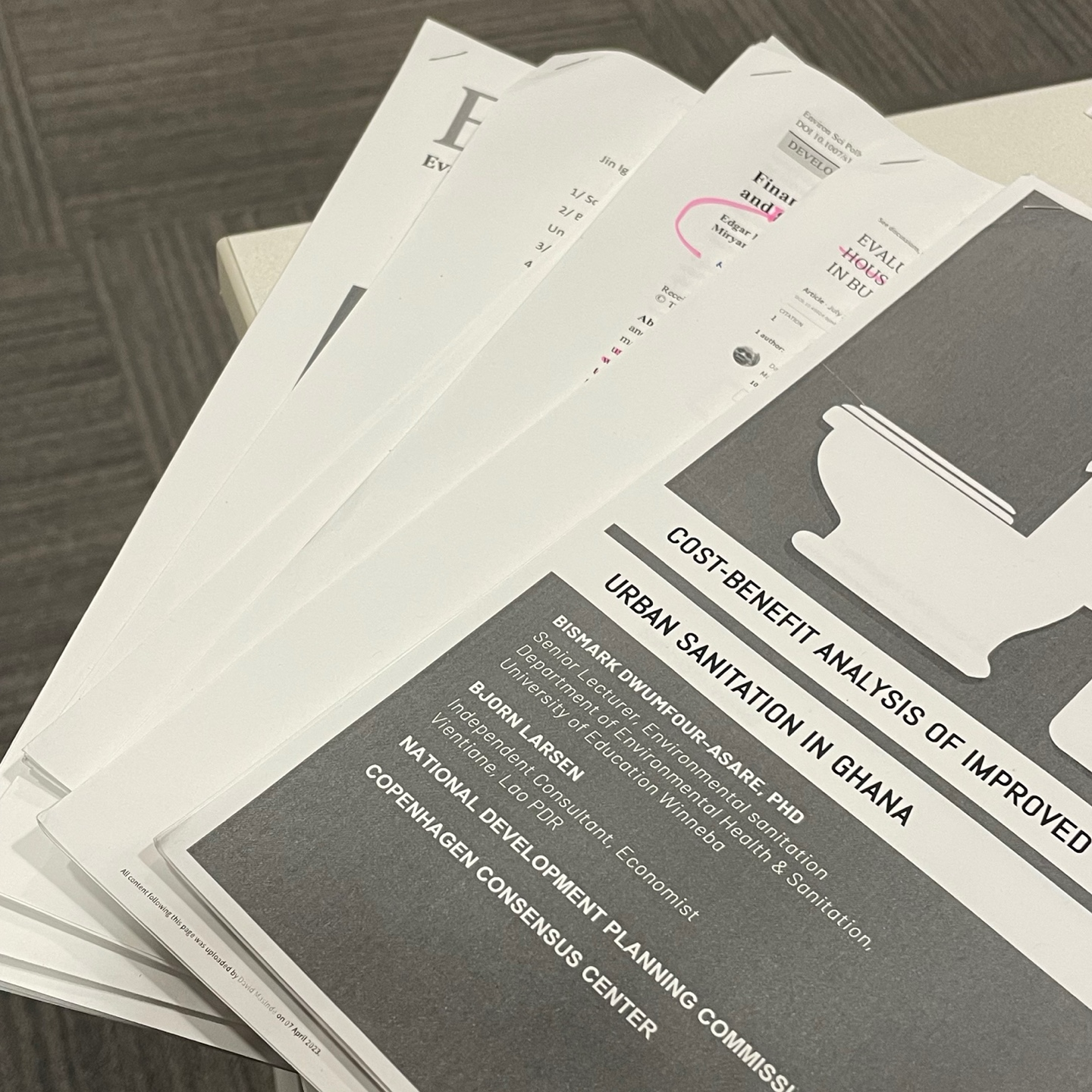
2. Benefit-cost analysis of improved urban sanitation in Ghana
- The paper assesses the benefits and costs of interventions to improve urban sanitation situation in Ghana. Benefits and costs of two main interventions: toilet subsidy with enforcement, and toilet subsidy only, are evaluated based on the available evidence from practices in the sanitation sector.
| Intervention Approaches | 1. Toilet subsidies with regulation enforcement | Households receive subsidies for toilet construction, and local authorities strictly enforce sanitation laws to promote private toilet installations. |
| 2. Toilet subsidies only | Households receive subsidies for toilet construction without enforcement of sanitation regulations. | |
| Cost-Benefit Analysis | 1. Costs | Includes toilet construction (e.g., biodigesters), operation and maintenance, cleaning expenses, hygiene promotion, and enforcement costs. |
| 2. Benefits | Quantified in monetary terms, including reduced healthcare costs, productivity gains, savings on public toilet use, and the economic valuation of lives saved. |
| Analysis period and discount rate | The interventions were assessed over a 20-year period, with a discount rate ranging from 5% to 14%, to calculate the Benefit-Cost Ratio (BCR). | |
| Results | 1. Toilet subsidies with regulation enforcement: BCR ranged from 3.4 to 4.9, depending on uptake rates. 2. Toilet subsidies only: BCR ranged from 3.4 to 5.6, with lower uptake rates leading to reduced benefits. |
|
| Conclusion | Both interventions yielded positive economic returns, but combining subsidies with regulatory enforcement resulted in higher sanitation improvements and net benefits. These findings suggest that enforcement mechanisms are crucial for maximizing the impact of sanitation programs. | |
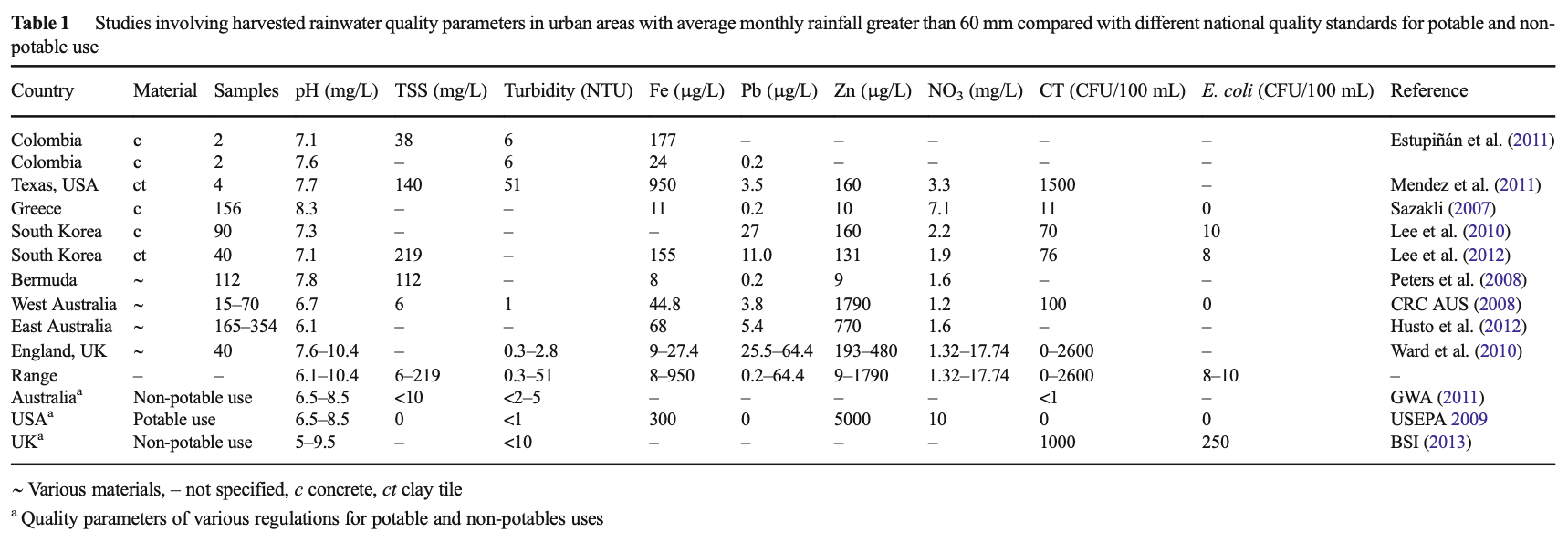
3. Financing feasibility of end-user designed rainwater harvesting and greywater reuse systems for high water use households
- The study evaluates the financial viability of Rainwater Harvesting (RWH) and Greywater Reuse (GWR) systems for high water use households in a residential complex in Bucaramanga, Columbia.
| Data collection | A survey was conducted among 35 households to assess water consumption patterns and preferences for RWH and GWR system adoption. | |
| System Design | System configurations | Three alternative configurations for RWH and GWR systems were proposed based on collected data. |
| Detailed design | The most feasible design was selected, and historical rainfall data was used to estimate capital and operational costs. | |
| Financial Analysis | Cost estimation | Initial investment and maintenance costs were calculated for each system. |
| Savings projection | Water savings were estimated based on reduced potable water consumption. | |
| Return on Investment (ROI) | The selected system configuration (Alt 2*) showed a 44% annual reduction in potable water use (131 m³), a 6.5% ROI, and a projected payback period of 23 years. | |
| Conclusion | The study highlights the financial feasibility of user-designed RWH and GWH systems at the household level, demonstrating their potential for urban water management and long-term cost savings. | |

* Alt 2 consisted of harvested rainwater for use in washing machines (0.67 p.eu.f.rw), sinks (0.72 p.eu.f.rw), internal taps (0.79 p.eu.f.rw) and external taps (0.78 p.eu.f.rw) and greywater from showers for use in toilets (0.94 p.eu.f.gw) (i.e. the five higher p.eu.f.gw).
4. Does 'low cost' urban sanitation exist? Lessons from a global dataset
| Background | Urban sanitation is costly, making access difficult in low-income areas. The study examines whether truly low-cost solutions exist and how they compare to conventional systems. |
| Objective | Assess the feasibility, scalability, and sustainability of low-cost urban sanitation through global data analysis. |
| Methods | The study collects data from reports, academic studies, and NGO records. It evaluates sanitation solutions using three key metrics: CACTUS, which measures cost-effectiveness in sanitation coverage, CAPEX, which assesses initial infrastructure costs, and OPEX, which examines operational expenses. A comparative analysis is conducted between low-cost and conventional sanitation models, supported by case studies from diverse urban contexts. |
| Results | The findings show that some low-cost sanitation models are cost-effective but often rely on external funding. Decentralized systems perform well in informal settlements but struggle with large-scale implementation. Long-term sustainability depends on strong governance and continuous financial support, while well-structured policies significantly enhance success rates. |
| Conclusion | Low-cost urban sanitation exists but requires a mix of affordability, technical feasibility, and institutional support for sustainability. |
5. Cost-benefit analysis of water source improvements through borehole drilling or rehabilitation: an empirical study based on a cluster randomized controlled trial in the Volta region, Ghana
| Background | Despite progress in water access, waterborne diseases remain a major public health concern in developing countries. Borehole drilling and rehabilitation with handpumps are potential cost-effective interventions, particularly in resource-poor and hard-to-reach areas. |
| Objective | This study estimates the costs and benefits of borehole drilling and rehabilitation by analyzing their economic impact, health outcomes, and non-health benefits. |
| Methods | A cluster randomized controlled trial (RCT) was conducted in rural Ghana to measure the reduction in diarrheal disease following borehole improvements. Intervention costs were estimated based on full investment and annual running costs. The benefits included: - Direct economic benefits: reduced child diarrheal disease treatment costs - Indirect economic benefits: improved health leading to increased productivity - Non-health benefits: time savings from improved water access. On-way and multi-way sensitivity analyses were performed to test result robustness. |
| Results | - The return on investment (ROI) per US$1 was US$9.4 for borehole drilling and US$14.1 for borehole rehabilitation. - Time savings accounted for 68% of total benefits, while averted child deaths contributed 15%. - Sensitivity analyses confirmed that borehole rehabilitation is more cost-efficient than new drilling under all conditions. |
| Conclusion | Investing in water improvements provides high economic and health returns, with borehole rehabilitation being the most efficient option. These finds supported increased government and international investments in water infrastructure, particularly in rural and underserved regions. |
'▪ Research' 카테고리의 다른 글
| KCI 등재지 목록 (0) | 2025.03.26 |
|---|---|
| IMS (IP Multimedia Subsystem) Diagrams (1) | 2025.03.08 |
| 2G·3G·4G·5G Network Architecture Diagrams (0) | 2025.02.12 |
| The Impact of Infrastructure on Development Outcomes | A Meta-Analysis (0) | 2024.09.17 |
| 아프리카 금융포용 필요성 및 전략방안 제시 (0) | 2024.08.24 |


